Orography and Places of Interest
Climate
Hydrography and Vegetation
Fauna
Routes
Access from Totana
Photos
 This
was the description of the 'Sierra de Espuña'
which 'Jerónimo Hurtado' made in 1584,
natural space of great scenic beauty and enormous
turistic interest, situated in the very centre of
the region of Murcia, with something more than 25,000
hectares forming part of the Andalusian ranges and
stretching between the regions of Mula and the Guadalentín
valley. It takes up land from Alhama, Aledo, Totana,
Mula and Pliego. Its great natural richness is so
important that in 1978 10,000 hectares were declared
as a Natural Park and nowadays they are considering
the possible extension of its parametres and its reclassification.
In addition, since 1973 more than 14,000 hectares
have been declared as a Natural Hunting Reserve.
This
was the description of the 'Sierra de Espuña'
which 'Jerónimo Hurtado' made in 1584,
natural space of great scenic beauty and enormous
turistic interest, situated in the very centre of
the region of Murcia, with something more than 25,000
hectares forming part of the Andalusian ranges and
stretching between the regions of Mula and the Guadalentín
valley. It takes up land from Alhama, Aledo, Totana,
Mula and Pliego. Its great natural richness is so
important that in 1978 10,000 hectares were declared
as a Natural Park and nowadays they are considering
the possible extension of its parametres and its reclassification.
In addition, since 1973 more than 14,000 hectares
have been declared as a Natural Hunting Reserve.
Sierra Espuña was one of the first great forestial repopulations in Spain. At the beginning of the century, under the direction of the engineer 'Don Ricardo Cordorníu Starico', a large part of the Sierra surface was repopulated. Nowadays, it´s ICONA (Instituto para la Conservacion de la Naturaleza - Institute for the Conservation of Nature) who are continuing with this work.
Orography and Places of Interest
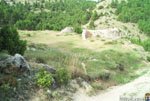
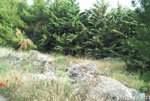
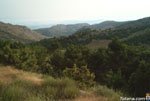
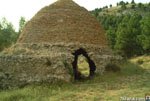
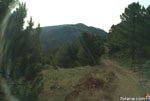
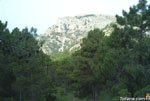
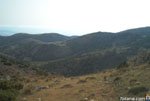
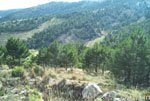
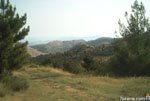
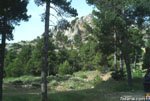
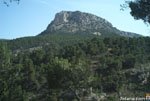
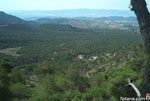
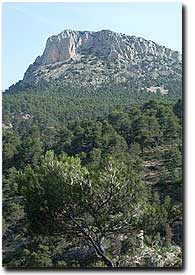
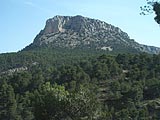
From an orographic point of view its made up of a heightened massif of deep interior vallies. Its geological materials, the oldest of the Precambrica era were affected by the jack knifing Alpine and are mainly made up of sandstone, dolomite, marl and limestone which have allowed the characteristic formation known as "Karst", giving place to the "Karstico" countryside; produced by the disolving of the carbonites of the limestone rocks eroded by rainwater and snow, like "El Gigante" where the erosion has created very sophisticated shapes in the rocks. Other places of interest are: 'El Purgatorio, Las Alquerías, La Arboleja, El Cerro de las Cabras, La Fuente del Sol, Las Cunas' - from where you can enjoy a beautiful view of the mountainous countryside-; 'La Umbría' or 'Pozos de la Nieve' - which we will talk about in more detail in the Places of Interest. The heights above sea level vary from 200 metres in the areas closest to the Gaudalentín Valley and 1,585 metres at its highest point, the famous 'Pico Morrón' of Totana or Espuña. To the South of this peak you can find one of the other most interesting areas called Collao Bermejo at 1,200 metres, it is a traditional area for hiking. The western area is taken up by 'LLano de la Cabras'. Another point of orographic interest is the region called 'Morrón Largo'.
Its climate is Mediterranean with mild temperatures. Cold, but short winters and warm, dry summers.
Although Espuña enjoys a microclimate somewhat more humid than the rest of the region, with average annual temperatures ranging between 13,5 ºc and in the cold periods temperatures lower than 7ºc; these temperatures vary with altitude, including reaching below 0ºc at 1,000 metres altitude some days of the year.
The average rainfall is around 5000mm, with October and April being the rainiest months. Occasionally, in Spring and Autumn this rain takes the form of hailstones and, although in scarse proportion, in Jaunary and February it takes the form of snow, these months enjoying the snowiest days. The summer months are referred to as the dry period.
 Actual
rivers do not flow through the Sierra although some
scattered springs run throughout the Sierra: La Carrasca
Malvariche, Los Algarrobos, Casa Rosa, streams and
ravines which flow into the rivers Pliego and Guadalentín.
The former recieves water from la Hoz and Malvariche
and the latter collects those from Molinos, Arcos,
Algeciras, Lebor and Espuña. These streams
are the cause of great erosion and drag materials
in times of torrential rain, but the erosive action
is less serious in the Sierra due to the blanket of
vegetation which covers it, as shouold be the case
for high mediterranean mountains, but man´s
actions and the successive repopulations have transformed
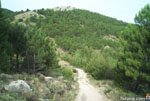
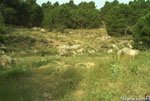
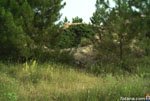
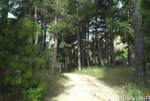
it and nowadays the mountainous countryside is dominated
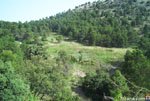
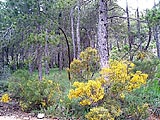
by three types of pine groves of repopulation; The
Carrasco pine grove - Pinus halepensis - an example
of the Rodeno pine grove - Pinus pinaster - and the
Negral pine grove - Pinus nigra salzmanni.
Actual
rivers do not flow through the Sierra although some
scattered springs run throughout the Sierra: La Carrasca
Malvariche, Los Algarrobos, Casa Rosa, streams and
ravines which flow into the rivers Pliego and Guadalentín.
The former recieves water from la Hoz and Malvariche
and the latter collects those from Molinos, Arcos,
Algeciras, Lebor and Espuña. These streams
are the cause of great erosion and drag materials
in times of torrential rain, but the erosive action
is less serious in the Sierra due to the blanket of
vegetation which covers it, as shouold be the case
for high mediterranean mountains, but man´s
actions and the successive repopulations have transformed
it and nowadays the mountainous countryside is dominated
by three types of pine groves of repopulation; The
Carrasco pine grove - Pinus halepensis - an example
of the Rodeno pine grove - Pinus pinaster - and the
Negral pine grove - Pinus nigra salzmanni.
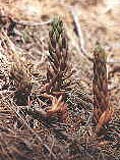 The
highest areas of the 'Sierra Espuña',
'Macizo de Gigante' and 'Carache',
their peaks continuosly punished by the wind, exhibit
a prickly scrub whose plants are stuck down to the
floor, looking like small prickly pillows of little
height (they barely reach a few inches) which mix
plants known as the "culo de Monja"
- Ennama anthyllis ; you can also see black sabina
- Juniperus phoenicea - and small dwarf pine scrubs
- Quercus rotundifolia. The undergrowth formed by
the scrub species like Juniper - Juniperus oxycedrus
- , negral espino - Rhamnus lycioides - Kermes Oak
- Quercus coccifera - a genista variety - Genista
longypes.
The
highest areas of the 'Sierra Espuña',
'Macizo de Gigante' and 'Carache',
their peaks continuosly punished by the wind, exhibit
a prickly scrub whose plants are stuck down to the
floor, looking like small prickly pillows of little
height (they barely reach a few inches) which mix
plants known as the "culo de Monja"
- Ennama anthyllis ; you can also see black sabina
- Juniperus phoenicea - and small dwarf pine scrubs
- Quercus rotundifolia. The undergrowth formed by
the scrub species like Juniper - Juniperus oxycedrus
- , negral espino - Rhamnus lycioides - Kermes Oak
- Quercus coccifera - a genista variety - Genista
longypes.
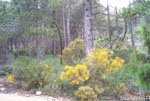
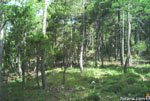
The small sources of water which are found in some spots of the Sierra form actual small streams with elm trees - Ulmus minosr - black poplars - Populusnigra - or honeysuckle - Lonicera implexa. Small springs also flow to the Espuña riverbed where its easy to recognise some plants such as the maidenhair well - Adiantus capillus veneris - and ferns which live around the springs and fountain sources and which are still used as a way to decorate houses; poplar trees - Populus alba -, willow trees - Salix pedicellata - and the poplar reeds appear on the riverbed of the permanent brooks.
The vegetation is always more exuberant in these areas that have stream beds than in the slopes of the mountains.
As the vegetation is varied, so is the fauna. In Sierra Espuña there are squirrels, as the pine cones scattered at the foot of the pine trees demonstrate; although they are not usually spotted on first glance, in Spring and Autumn its easy to spot them due to the greater activity, given that at this time of year they collect their food: acorns and pine nuts in order to survive during the winter and in the spring to feed their young. The squirrel which inhabits the Sierra is the grey squirrel - Sciurusvulgaris hoffmanni-. Alongside this species we can find: hares - lepus capensis - rabbits - Oryctolagus curuculus - wild boar - Sus Scrofa - jays - Garrulus glandarius - and snakes - Malpolon monspesularius - . Also, preditors such as foxes - Vulpes vulpes - wild cats - Felix Silvestris - genet - Genetta genetta - which are very adept at hunting.
As you go up the masses of the Espuña you
can make out birds of prey such as the Golden Eagle
- Aquila chrysaetos - the sparrowhawk - Accipiter
nisus, kestrel - Falco tinonculus - goshawk - accipiter
gentillis - and others like choughs - Pyrrhocarax
pyrrhocorax - rock martins - Ptyonoprogne rapestris
- . At dusk you can see nocturnal birds of prey like
owls - Athene noctua.
In addition, there are also sedentary birds like the
magpie - Pica pica - and jackdaw - Corvus monedula.
In winter migratory birds appear which nest in the
Sierra, like the Thrush - Turdus philomelos –
and blackbirds- Turdus menila.
 In
the brooks and fountain springs you can find green
frogs - Rana perezi - Salamanders - Salamandra salamandra
- and, giving beauty and colour to the countryside,
butterflies - Aricia morronensis - and reptiles like
the angry viper - Vipera latasti - and lots of other
small animals which vary according to the habitat
that the Sierra provides, whether its forest, rocky
places, mountainous slopes, brooks or springs.
In
the brooks and fountain springs you can find green
frogs - Rana perezi - Salamanders - Salamandra salamandra
- and, giving beauty and colour to the countryside,
butterflies - Aricia morronensis - and reptiles like
the angry viper - Vipera latasti - and lots of other
small animals which vary according to the habitat
that the Sierra provides, whether its forest, rocky
places, mountainous slopes, brooks or springs.
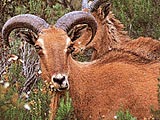
In 1970 ICONA incorporated the "muflon del Atlas o arrui" - Ammotragus lervia - (similar to mountain goat with twisted horns) to the area, an animal easily acclimatised to the Sierra and which breeds easily. Nowadays more than 500 inhabit the Sierra.
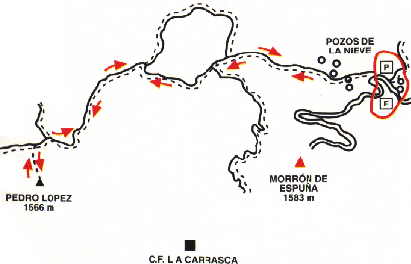
Access to Sierra Espuña, in which Totana shares jurisdiction with Alhama, means you have to go inside a natural park, with its high mountainous land, where you find nature intimately intertwined with man.
Route 1
Route 2
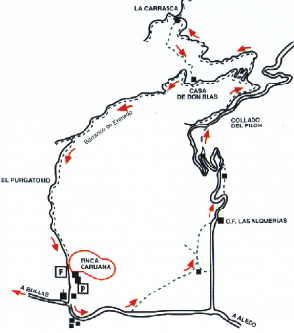
The main access is via the Aledo road. Leaving behind the 'Santa Eulalia' Hermitage, some 3km from the town, a tarmaced forest road on the right leads you to the Southern side of the Sierra towards 'Las Alquerías' and 'Collao Bermejo'.
|
|
|
|||||||||
|
|
|
|||||||||
|
|
|
|||||||||
|
|
|
|||||||||
|
|
|
|||||||||
|
|
|
|||||||||
|
|
|
|||||||||
|
|
|