The gastronomy of Totana is renowned for the simplicity of its dishes in which both elements of traditional cooking and nouvelle cuisine are combined. Tradition dictates a style of cooking which is heavily influenced by the passing of the seasons and festive days and also makes great use of the produce of the celebrated Murcian huerta: such as the famous pumpkins grown in Totana, aubergines, artichokes, courgettes, green pepper, pulses and rice. All this without failing to mention meat, especially rabbit, and flour which is used to make porridge.
In order to comprehend the socio-cultural importance of the gastronomy for the inhabitants of the area, we could refer to the 'tortas de pimiento molido' (typical ground pepper pancakes), 'chicharrones' (pieces of pork) which together with a café con leche make a typical leisurely breakfast.
Another time-honoured custom, to
be enjoyed amongst friends , is that of the midday
'aperitivo' (aperitif) which traditionally
includes beer, wine, the typical dish of michirones,
cod with tomatoes, fried almonds, the various renowned
sausages of the region and, and always eaten lastly,
dressed lettuce hearts.
'Migas con tropezones' (fried breadcrumbs
with small pieces of meat) is another typical dish
which is eaten all year round. Rice dishes of all
different types are also popular, as are dishes based
on meat, especially rabbit, which can be cooked in
tomatoes, with garlic etc.
 An
established ritual, which takes place in winter, amongst
families in Totana is that of the 'matanza del
cerdo' (the slaughter of the pig). This takes
place towards the month of November and has brought
about the popular saying 'Para San Andrés,
mata tu res' (Kill your beast for Saint Andrew).
This means that the family larder can be stocked for
the coming winter and all the typical sausage meats
can be prepared. And all this serves to contradict
the timeworn proverb which reads as follows: 'En
Totana donde se acaba el pan antes que la gana'
(In Totana, where the bread runs out before it fills
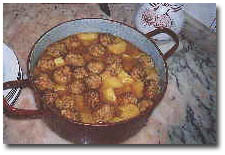
you up). Stews are also popular and be served with
meatballs or, more typically, vegetables together
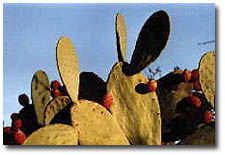
with beans, chick peas, prickly pears and pork. Rice
dishes can contain meat, vegetables or snails.
An
established ritual, which takes place in winter, amongst
families in Totana is that of the 'matanza del
cerdo' (the slaughter of the pig). This takes
place towards the month of November and has brought
about the popular saying 'Para San Andrés,
mata tu res' (Kill your beast for Saint Andrew).
This means that the family larder can be stocked for
the coming winter and all the typical sausage meats
can be prepared. And all this serves to contradict
the timeworn proverb which reads as follows: 'En
Totana donde se acaba el pan antes que la gana'
(In Totana, where the bread runs out before it fills
you up). Stews are also popular and be served with
meatballs or, more typically, vegetables together
with beans, chick peas, prickly pears and pork. Rice
dishes can contain meat, vegetables or snails.
Once spring and Easter have arrived, the gastronomy of Totana relies even more heavily upon a wide variety of both fish and vegetables, cod cooked with tomatoes is amongst the most popular dishes of the region.
The summer diet is lighter and is
largely based on cold dishes such as salads, fruits
from the huerta with the most typical dish being salted
sardines served with fried eggs.
On Sundays throughout the year, most families sit
down to rice with rabbit followed by figs with almonds
or rice pudding.
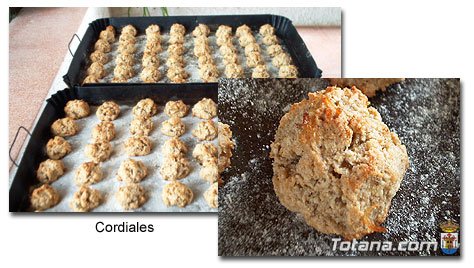
Another popular practice is to enjoy some buñuelos (typical doughnuts) late afternoon. Whilst on the subject of confectionery, we must mention the mantecados (lardy cakes), tortas de Pascua (Christmas cakes) and other festive treats such as liados and cordiales which are baked by the housewives of the region for the Aguinaldo (Christmas box). This custom is undoubtedly one of the oldest gastronomical traditions in Totana.
As far as drinks are concerned, perhaps the most typical is the famous revuelto (meaning mixed up or confused) which as its name suggests is a mixture of anis and dessert wine. Other traditional drinks are paloma (white anis), which can be mixed with lemon syrup and then becomes known as canario.
"Reappearing"
Figs
 Tradition
has it that a long time ago there was a mighty summer
storm in the town of Totana, which swept away some
of the fields, as a consequence the figs trees were
left almost entirely deprived of their most prized
fruit. The people of Totana grieved because that year
they were not going to have their tasty fruit, but
the surprise came when Autumn arrived and all the
fig trees produced a second batch of fruit and consequently
they were able to enjoy the flavour of their figs.
Ever since then the people of Totana on the day of
´San Antonio´ (st. Anthony) throw
part of the fig harvest away, as Totana enjoys such
a harvest twice a year, in Summer and in Autumn.
Tradition
has it that a long time ago there was a mighty summer
storm in the town of Totana, which swept away some
of the fields, as a consequence the figs trees were
left almost entirely deprived of their most prized
fruit. The people of Totana grieved because that year
they were not going to have their tasty fruit, but
the surprise came when Autumn arrived and all the
fig trees produced a second batch of fruit and consequently
they were able to enjoy the flavour of their figs.
Ever since then the people of Totana on the day of
´San Antonio´ (st. Anthony) throw
part of the fig harvest away, as Totana enjoys such
a harvest twice a year, in Summer and in Autumn.